Title: Using Rust for an Undergraduate OS Course
Date: 2014-01-01
Tags: rust
Author: David Evans
Template: graph3
Perhaps the most controversial decision about this course was the choice
of [Rust](http://www.rust-lang.org), a very new and immature programming
language being developed by Mozilla, as the primary language for course
assignments. In general, I am very happy with how this worked out,
although there were significant drawbacks to using such a new language
and student opinions on this were fairly mixed. Next, I'll describe
more why I decided to use Rust and what impact it had on the course.
(For more on the overall context and design of the class, see the [Course Wrapup](|filename|./wrapup.md).)
## Unacceptability of C
The default language choice for Operating Systems courses is C. Nearly
all (at least 90% from my cursory survey, the remainder using Java; if
anyone knows of any others, please post in the comments!) current and
recent OS courses at major US universities use C for all programming
assignments. C is an obvious choice for teaching an Operating Systems
course since is it the main implementation language of the most widely
used operating systems today (including Unix and all its derivatives),
and is also the language used by nearly every operating systems textbook
(with the exception of the Silberschatz, Galvin, and Gagne textbook
which does come in a [Java
version](http://www.amazon.com/Operating-System-Concepts-Abraham-Silberschatz/dp/047050949X)).
To paraphrase one syllabus, "We use C, because C is the language for
programming operating systems."
C is an obvious choice, but its also an _obviously bad_ choice. C was a
great language when it was designed in the late 1960s, to make up for
not having a machine powerful enough to run languages like Algol 60
which were already available, but too complex to compile without a huge
(by 1960s standards) amount of memory.
An example of a design decision made to save memory in C, is the use of
`=` as the assignment operator (previous languages, such as Algol, used
an arrowlike two-character sequence, `:=`, which makes the directional
nature of assignment clear). From kindergarten on, people learn the
mathematical meaning of the `=` symbol as a Boolean operator that is
true when the values on both sides match. Using it to mean assignment
is confusing and misleading, but was a "good" decision for C since it
saved one byte for each assignment in program text. Since assignments
are much more common than equality tests, using `==` for equality and
`=` for assignment saves bytes in source code files, which was a lot
more important than providing a coherent model or understandable
notation for Dennis Ritchie and Ken Thompson in the 1960s.
Computers have changed a bit since 1972 - our programming tools should too!
(We should still [study and learn from history](|filename|../classes/class3/class3.md), though.)
By the time students make it to cs4414, they have recovered from the
atrocities of `=` meaning assignment, but many others don't make it over
this (unnecessary) hurdle and suffer greatly because of it, if they have
the misfortune of starting out with a programming language that uses
C-like syntax.
More important problems with C for teaching an OS course are its lack of
type safety and memory safety, and its lack of any intrinsic support for
concurrency. It was the correct decision to not include these things in
C for the purpose for which it was designed in the 1960s and 1970s, but
there have been a few advances in programming languages, compilers, and
architecture since then, and the relative costs of things have changed,
as well as the increased importance of security and robustness.
C may be the language of operating systems today (and since the 1970s),
but it is also the language of buffer overflow vulnerabilities, dangling
pointers, double frees, memory leaks, undefined behavior, and race
conditions. To me, it would seem inconscionable to have students use C
in a way that is likely to lead to programs riddled with security
vulnerabilities and robustness problems. On the other hand, actually
teaching students to use C in a responsible way would probably require
at least the full semester as well as use of many other tools[^1],
including some that are only available commercially.
As far as I could tell, none of the OS courses that use C had any time
for teaching students how to write reasonably safe C code (and none of
the C-based OS textbooks I looked at made anything beyond superficial
attempts to address safe programming practices in C), which is
understandable given how much time it takes to learn the other topics in
an OS class, but from my perspective, seems reckless and irresponsible.
A C programmer who knows how to hack on an OS kernel, but doesn't know
how to avoid memory leaks, double frees, and undefined behavior, should
not be unleashed on an unsuspecting code base!
# Alternatives to C
Having eliminated C as an irresponsible choice for teaching an OS
course, I had to select another language. (I briefly considered not
using a particular language, but since it seemed important to provide
starting code to have interesting assignments and to cover some things
in class using a particular language, this didn't seem like a viable
option to me.)
I considered five possibilities: Java, Python, D, Go, and Rust.
**Java.** Okay, I didn't really consider Java, since I personally find
it to be unpleasant to program in Java, but need to mention it since
it is the only commonly used alternative to C for OS courses (some examples: [University of Massachusetts CMPSCI 377: Operating Systems](http://lass.cs.umass.edu/~shenoy/courses/377/), [University of Texas: CS 372: Operating Systems](http://www.cs.utexas.edu/~witchel/372/syllabus.html)). The
advantage of using Java over C is that it provides type safety and
automatic memory management, so does not suffer from most of the
security and robustness problems in typical C code. It does not,
however, provide enough low-level access to system resources to
adequately cover many important operating systems concepts, and is not
a language anyone would use to write an OS kernel. Java also suffers
from lack of useful expressiveness, only finally and awkwardly adding
lambda expressions in Java 8 (expected to be released in March 2014,
neary 19 years after the initial Java release!)
**Python.** Unlike Java, Python is a quite tasty and elegant language,
and has the advantage that many complex algorithms can be expressed
clearly in a few lines of Python code. When I was on leave at
Udacity, I'd had some discussions with [Matt
Welsh](http://www.mdw.la/) about teaching an open on-line systems
programming course using Python, and he came up with a plan for
teaching many of the concepts needed to build scalable, robust,
distributed systems using Python. It seems possible to do a good job
teaching some of the topics in an OS course using Python labs,
including distributed systems and scheduling, but, like Java, not
well-suited to exploring lower-level topics like memory management or
a language one could imaging using to implement an OS kernel.
**D.** D is a programming language designed as a successor to C++ that
has been around since 2001. D has some very nice features: it
provides reasonable support for functional programming, static types
with type inference, and some concurrency constructs. The biggest
disadvantage of D compared to Rust is that it does not have the kind
of safety perspective that Rust does, and in particular does not
provide safe constructs for concurrency. I prefer Rust's memory
management options, although D provides a fairly similar combination
of garbage collected objects and objects with explicit memory
management, it does not provide any of the safey guarantees or
lifetime model that Rust does. The other argument against using D is
that it has been around more than 10 years now, without much adoption
and appears to be more likely [on its way
out](http://stackoverflow.com/questions/743319/why-isnt-the-d-language-picking-up)
rather than increasing popularity. This shouldn't be a major factor
for an academic course, but I'd much rather be teaching something that
is in an early phase of exponential popularity growth rather than
something that appears to be declining.
**Go.** Go is a systems programming language first released in 2007 that
was initially designed by a team including Ken Thompson (C
co-designer) and Rob Pike at Google. Unlike D, it seems to have a lot
of momentum behind it, no doubt partly due to Google's support. There
are [some preliminary, although tastelessly named,
attempts](http://gofy.cat-v.org/) to write operating systems in Go,
but the intertwining of the runtime with the compiler makes this quite
difficult in Go (in comparison to Rust where the runtime can be easily
separated). I'm not aware of any undergraduate operating systems
courses that have used Go, but MIT's graduate [6.824: Distributed
Systems](http://pdos.csail.mit.edu/6.824/labs/lab-1.html) course and
CMU's [15-440: Distributed
Systems](http://www.cs.cmu.edu/~dga/15-440/F12/assignments.html)
course used Go. Go is a fairly new language, but mature enough to
have a stable, industrial-strength compiler with great performance,
and good documentation (and mature enough to have an [idiom
guide](http://golang.org/doc/effective_go.html)). Go is also similar
enough to C to be easy for C programmers to learn and has no major
learning curve hurdles.
So, Go definitely has a lot of things going for it, and initially I
planned to use Go for cs4414 until learning about
[zero.rs](http://thechangelog.com/zero-rs-write-rust-without-a-runtime/).
After looking into Rust more, it seemed like Rust had several key
advantages both as a systems programming language in general, and as a
primary language for teaching an operating systems course.
**Note Added 4 Jan:** Some commenters are taking this as being negative
on D and Go. That's not my intent at all - its great that people are
working on developing these languages. In the larger picture, any
progress for any of these languages is a great thing, and I would be
very happy to see others developing courses using Go and D. The first
step is to realize we don't need to keep using C just because everyone
is, but should consider the possible advantages and disadvantages of
other languages that solve problems inherent in C's design. I found
Rust to be the most exciting and promising option, as discussed below,
but that doesn't mean we shouldn't be exploring possibilities with
other languages also.
## Reasons to Use Rust
Rust is a new systems programming language being developed at Mozilla.
It is primarily driven by the needs of the Mozilla's
[Servo](https://github.com/mozilla/servo/) project to build an
experimental multi-core browser engine. Rust adopts a C-like syntax,
but is much less tied to C's semantics or being easy for C programmers
to learn than Go or D, and its overriding design goal is to support safe
concurrency in a practical way. The first public release was in January
2012, so Rust is a very new and immature language, but it has some
innovative and very appealing features for use in systems programming
and teaching an operating systems course.
1. Rust **changes the way you think.**
At least for "ivory-tower" types, the only reason to learn new languages
is for their power to change the way you think.[^2] Neither Go nor D really
do this (at least for anyone who has previously programmed in C, Java,
and Python), but Rust does a great deal. Rust requires programmers to
think carefully about how objects are shared and used, and this changes
the way you think about programs and algorithms.
2. Rust provides **simple and safe concurrency** mechanisms, and a useful and
intellectually interesting **task abstraction**.
I'm not aware of any other language that has concurrency constructs
as elegant and easy to use as Rust's `spawn`, and I don't know of any
language that comes close to the race-free safety guarantees provided by
Rust. The alternative with language like C and Go, is to have students
get in the habit of writing programs riddled with data race bugs. Such
programs tend to work well enough to be satisfactory for course projects
(where the occasional crash or corrupted data is acceptable), but are
increasingly unacceptable in the real world. The next step is to use
available tools to detect races (e.g., [Go's race
detector](http://blog.golang.org/race-detector)), but these present
another tool to use and learn about, are incomplete (only detect races
that occur on executions), and much less satisfying than the static,
language-based mechanisms provided by Rust.
Rust's task abstraction is somewhere between a thread and process: it
provides the memory isolation safety of a process while allowing safe
memory sharing, but with the lightweight costs of a thread requiring no
context switching. This is a useful thing for programmers, but also a
great thing for students to learn about and understand in an operating
systems course. Along with the task abstraction, Rust provides good
abstractions for communication between tasks including a simple channel
abstraction and [abstractions for shared mutable
state](http://static.rust-lang.org/doc/0.8/extra/arc/struct.RWArc.html).
3. Rust provides **strong memory safety guarantees**, but still allows
programmers **explicit control over memory management**.
The main alternatives provide two extremes: C provides no memory
safety but fully explicit control over memory management; Go and D
provide memory safety but with all objects being automatically managed
with a garbage collector (over which languages users have little
control). Rust provides a way for programmers to declare objects that
are automatically managed or explicitly managed, and statically checks
that explicitly managed objects are used safely. This is done using a
notion of ownership, and type rules for controlling how ownership is
transferred between references (e.g., you can pass an owned object
temporarily to a function as a borrowed reference, and can have more
complex ownership types to enable controlled sharing). These rules
guarantee all memory is safely deallocated, and the sharing restrictions
are essential for providing safe concurrency.
4. Rust provides good mechanisms for **higher-order procedures**, and
many library types are designed in ways that encourage students to use
them.
One of the biggest embarrassments about our department's standard curriculum is that students can reach a 4000-level class without ever encountering a higher-order procedure (as opposed to the sadly rarely-offered [alternative intro course](http://www.cs.virginia.edu/evans/cs1120-f11/) which introduces higher-order procedures in the first assignment), so I thought it was essential to use a language that supports higher-order procedures and provides good opportunities to use them effectively. Rust provides a simple syntax for lambda expressions, and lots of good ways of using them including in the [RWArc abstractions we used in the starting code for PS3](https://github.com/cs4414/ps3/blob/master/zhtta.rs).
5. With it strong emphaisis on safety, Rust still provides an **escape hatch** to allow students to experiment with unsafe code.
The Rust compiler normally disallows any code with implicit data races or unsafe memory use, but the language provides the `unsafe` construct for surrounding code that may be unsafe. This can certainly be abused (and I regret not providing some guidelines or rules to prevent students from overusing it, which some students did on some assignments), but is also very useful for being able to show simple but unsafe code and for understanding what is necessary to make code safe. For example, we used this in [PS1](|filename|./ps/ps1/ps1.md) where students added an unsafe counter to a simple web server, and then in [PS3](|filename|./ps/ps3/ps3.md) there was a problem where students had to implement it in a safe (race-free) way. The `unsafe` escape hatch also makes it possible to include assembly code in Rust programs, and to easily use libc.
6. Rust is **open source** and has an **open development** process.
The Rust source code is [available](https://github.com/mozilla/rust) for everyone to read, and the Rust language designers discussions are on an [open mailing list](https://mail.mozilla.org/pipermail/rust-dev/). (Go is also [open source](https://code.google.com/p/go/source/checkout) and has an [open developer discussion](https://groups.google.com/forum/#!forum/golang-dev), so this is not a particular advantage of Rust over Go.)
7. Rust has a vibrant, helpful, and **friendly community**.
This is obviously subjective, but the novelty and philosophy of Rust
are well-suited to a devoted development team and user base, and I got a good sense that the community would be very helpful in my early interactions on the Rust IRC. For an immature language, having a supportive community is really important, and our class benefitted greatly from help from the Rust community throughout the course.
8. The immaturity of Rust means there are **lots of opportunities to make contributions**.
Rust's immaturity is its biggest drawback (more in the next section), but it also has a good side. Using an immature language means there are lots of opportunities to make substantial contributions, and I tried to encourage students to view anything essential lacking from the Rust ecosystem as an [opportunity for them to create it](http://www.dorina.org/pubs/). By the end of the course, one of the students had [made changes that
were accepted into the main Rust compiler](https://github.com/mozilla/rust/pull/10477), other group had built a [regular expression library](https://github.com/ferristseng/regex-rust/tree/master), [true random number generator](https://github.com/wbkostan/cs4414-ps4), and [real-time audio](https://github.com/victor-shepardson/rust-audio-experiments), among [other projects](|filename|./ps/project/results.md); and several students are now working on writing [tutorials](https://github.com/rtm9zc/rust-tutorial/wiki) and documentation that will be useful for students in next semester's class and anyone else who wants to learn Rust. It is hard for me to imagine similar contributions being possible to the extremely mature C ecosystem.
## Reasons Not to Use Rust
There are lots of great reasons to use Rust in an OS course, but two major (and one minor) ones not to:
1. Rust is a **very immature** language (at version 0.7 at the time we started the class).
The immaturity means there is little documentation, and much of what existed was not consistent with the latest version. It also means the language continues to change in subtantial and non-backwards-compatible ways which mean code we wrote for the class broke when we moved to version 0.8 mid-semester, and many of the libraries available no longer worked. The lack of documentation is a serious problem, and was the main cause of frustration for students in the class. There is a lot of ongoing effort now (including some from students in the class) to improve the available documentation for Rust, so this problem should diminish rapidly.
The more fundamental problem with an immature language is that we lack the experience to have developed idioms and conventions for using the language effectively. Forty years of experience with C has led to the development of lots of idiomatic ways of doing things, and in most cases, evolutionary pressures should lead to good solutions, and these solutions are documented in lots of places that are fairly easy to search (e.g., [stackoverflow](http://stackoverflow.com/search?q=%5Bc%5D+memory+leaks)).
2. Rust has a very **steep learning curve** and requires programmers to **think differently**.
As mentioned before, for ivory-tower folks the fact that a language makes you think differently is a great property, but this also makes it a lot harder to learn and is often very frustrating for people used to thinking certain ways and unable to do the things they think should be easy. Good tutorials (which hopefully we'll have ready for next semester) and exercises can help, but the way Rust pointers work is different enough from what people with experience using C and Java expect that it seems necessary to get over some pretty big hurdles before writing any non-trivial programs in Rust.
3. Rust is **not widely used** in industry (yet), so it is disadvantageous to students compared to gaining experience using a commonly used language like C.
I view this as a minor reason, since I don't think its really the mission of a university CS curriculum to prepare students with particular job skills[^3], but many people bring this up so it is worth discussing. One of the problems with this view is it leads to a circle of inertia: industry uses C/Java for programming projects because that's what their current team knows and it is easy to hire C/Java programmers, and universities train C/Java programmers because that's what industry wants. Academia should be _leading_ industry, not following it, and one way to do that is by producing graduates who know about things that are not yet widely known in industry.
For individuals, however, this larger view is not too helpful (trying to change industry doesn't provide much solace for the poor sap who can't get a job, although our graduates usually have a plethora of interesting job offers, at least for the 4th years, often before finishing this class). More pragmatically, I don't see that a one semester course using C is enough to really increase someone's value as a C programmer. There are thousands of programmers with decades of experience using C, and it takes many years using C to be a top-level C programmer, so a single semester of coursework is unlikely to make someone a particularly valuable C programmer if she wasn't already a valuable employee because of her general knowledge, ability, and talents. On the other hand, if Rust takes-off as an industrial systems programming language, being one of a small number of people who already have significant experience with the language should be a considerable advantage.
# Programming Assignments and Reactions
Initial student reactions to Rust were largely negative.
The [first assignment](|filename|./ps/ps1/ps1.md) provided a few
exercises to get students started programming in Rust and then expected
them to modify a simple web server given code we provided to add an
unsafe counter and make it respond to file requests. Responding to file
requests required extracting the pathname from the requested URL and
implementing simple file I/O. Since Rust doesn't yet have much support
for strings, extracting the pathname was much more challenging than
students expected, and this caused a lot of frustration. All of the
students in the class were able to get the counter to work and 61 out of
65 students were able to get the file request serving to work. Of the
four who couldn't, three encountered into problems with types they were
not able to resolve and the other one was not able to figure out how to
do string extraction.
The submission for PS1 also included an open resonse question,
> (Optional) If you have any additional comments about this assignment or about how the course is going so far, here's your chance:
The responses are [here](|filename|./ps/ps1/ps1comments.md). I
encourage you to read all of them, but a few representative comments
give the prevailing view:
> _Rust is interesting. I'm not sure if I like it as a choice for the class language yet or not. The safety of the language makes it valuable for operating systems, but the lack of documentation makes doing assignments difficult. To make matters worse, much of the language has been re-factored since the documentation was written, meaning that many of the methods and procedures that are documented no longer work in the current version._
###
> _Rust documentation is god awful. The web server portion of this assignment should've taken me all of three minutes, instead I spent 1.5 hrs trying to use undocumented methods. It would be nice if you could provide us with some common code snippits like reading files for instance. That is not something I should have to spend 20 minutes trying to figure out. I have the feeling that rust is going to be counter productive to actually learning anything about operating systems due to the excessive time spent on fruitless google searches/banging my head on the keyboard._
###
> _Using Rust was painful. Some library functions from Rust either didn't work correctly or yielded unexpected results that I didn't want, especially the ones from str module. So I decided to custom-develop the library functions by myself instead of being subordinate to language specific issues. I think we can better use our time learning more about the OS instead of wrestling with language specific semantics or bugs._
For the [second problem set](|filename|./ps/ps2/ps2.md), which was
focused on learning about processes, students implemented a shell. We
provided a very minimal starting code that could execute a foreground
program, and students had to add internal commands, support for
background processes, I/O redirection, pipes, and an extension of their
own design to the shell.[^4] Students worked in teams of two for this
assignment, and in addition to submitting their code and answer to some
questions in a [web
form](https://docs.google.com/forms/d/1LTwnXiA7RSy3yak6R98JMROLgVlIZIOGsZmkhBUbBXw/viewform)
did a demo with me or one of the course TAs where they showed off their
shell and answered questions about their design and code. Of the 33
teams, 27 were able to succesfully implement all the required problems.
[Problem Set 3](|filename|./ps/ps3/ps3.md) focused on synchronization,
scheduling, and memory management, and required students to implement a
much better zhtta web server than the zhttpo server from PS1. They had
to make a safe visitor counter using Rust's concurrency abstractions,
implement an improved scheduler for a multi-tasking web server,
integrate server-side shell includes (using their shell from PS2) into
the server, and improve performance by adding caching. The final
problems challenged students to improve the server's performance in any
way they could (without sacrificing safety) or add some new
functionality. Students worked in teams of three students, and each
team did a demo with me after submitting the assignment. All but two of
the teams[^5] were able to get everything working (although many did
memory caching in a way that actually reduced the performance of their
server by requiring too much synchronization), and the remaining teams
were able to get most of the extended functionalities working. By this
point, many students were starting to really enjoy programming in Rust,
and the concurrent programming required for the web server really made
some of the advantages of Rust clear.
For the final assignment, students had an [open-ended
project](|filename|./ps/project/project.md), and were free to use any
language they wanted (or to do something that was not
language-specific). A bit over half of the students ended up [using
Rust for their project](|filename|./ps/project/results.md). Many did
things that I think are very impressive and will be useful to the larger
Rust community and to future offerings of this class including Iron Kernel (an ARM
kernel written in Rust with a simple file system which I'm hoping to use
for an assignment in next semester's class), Rust
Raytracer (a concurrent 3D renderer), tRustees: True Random
Number Generation, and Regular
Expression Library, as well as projects to develop Rust tutorials.
See [Project Submissions](|filename|./ps/project/results.md) for links
to all the projects and credits.
# Evaluations
The final survey and [official course
evaluation](|filename|./CS-4414-001-Fall-2013.pdf) included several
questions intended to evaluate student's experience using Rust in the
class. Some of the results are below; see the [Final Survey
Results](|filename|./finalsurvey.md) for full details and more comments.
| | |
|-|-|
|
This could be interpreted quite positively, with nearly 70% of students not against using Rust in future offerings, and many more in strong agreement with this than in strong disagreement. On the other hand, just over 30% of students think Rust should not be used for future offerings of the course.
|
Despite my enthusiasm and view that teaching C in the standard way would be irresponsible, the majority of students still wanted to have at least some C programming in the course. I hope with improved Rust documentation and tutorials, and a Rust kernel assignment, students will feel less longing for C next semester.
|
|
This seems like more than I would expect, but it will be great if nearly half the students end up using Rust after the class. I don't see it as a problem when students don't though; the things they learned from programming in Rust should make them better programmers in any language.
|
More than half the students made regular use of the #rust IRC. Having immediate access to helpful experienced Rust programmers and developers was a huge win.
|
Students overall have mixed views on Rust, with lots of extremes (some
people love it, others really hate it). I view that as a fairly
positive result for a first run of a course like this, and especially in
light of most of the comments that are primarily about lack of
documentation that should be much improved next semester. I'll be
worried if these results don't improve next semester, though. See the
[Final Survey Results](|filename|./finalsurvey.md) for more specific
comments.
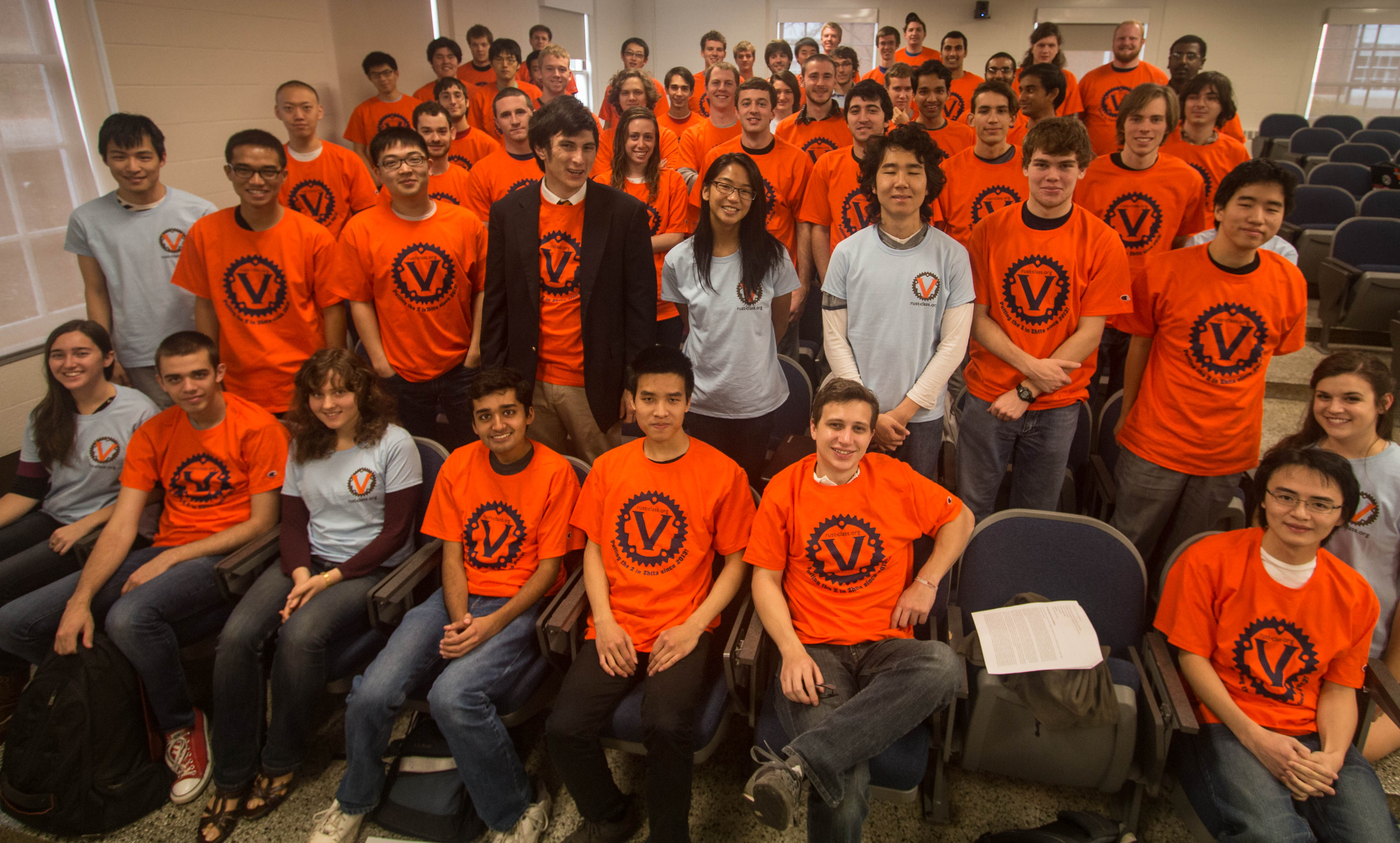
cs4414 Fall 2013 Graduates
# Conclusion
In summary, I really enjoyed using Rust and think it is a very promising
language with a lot of potential for teaching, as well as for industrial
systems programming.
It is irresponsible for universities to continue to teach students to
write C code riddled with security vulnerabilities, memory leaks, and
race conditions. There are good alternatives available, and Rust
appears to be the most promising to me, but I hope others will explore
both ways to teach students to write safe C code as well as different
languages for teaching systems programming that don't suffer from the
legacy flaws of C.
[Sign-up for the open Spring 2014 Course](|filename|./spring2014.md)
_Thanks for reading such a long post! I would be very happy to read
comments from any students, people who teach OS courses, or anyone else
who is interested in programming languages and operating systems. Feel
free to post public comments below, or [email me directly](http://www.cs.virginia.edu/evans) with private
comments._
**More discussion on [Reddit (Programming)](http://www.reddit.com/r/rust/comments/1ucrfg/using_rust_for_an_undergraduate_os_course/) and [Reddit (Rust)](http://www.reddit.com/r/rust/comments/1ucrfg/using_rust_for_an_undergraduate_os_course/) and [Hacker News](https://news.ycombinator.com/item?id=7009414).**
comments powered by Disqus
[^1]: Back a couple decades ago, my first major research project as a
graduate student was a [LCLint (later renamed
Splint)](http://www.splint.org), a static analysis tool for C designed
to provide abstract datatypes, check for consistency with
specifications, and overcome other problems with C including [memory
management mistakes and null
dereferences](http://www.cs.virginia.edu/evans/pubs/pldi96-abstract.html).
I had tried once to use C with static analysis in [a course
assignment](http://www.cs.virginia.edu/~evans/cs201j-fall2002/problem-sets/ps6/),
but it proved to be very challenging for students to get with only one assignment.
[^2]: For non-ivory tower types, the main reason to learn a new
programming language is that it makes you more productive (e.g., the
main argument for Go and D) or that it is necessary for joining some
project using it (e.g., main reason people need to learn C) or targeting
some desirable platform (e.g., ObjectiveC for iOS). For working
programmers, having to learn a new way of thinking to use a language is
a big downside! This is the main reason Java was successful (it was
immediately accessible to C++ programmers without requiring them to
think differently, other than freeing up the parts of their brain they
were using to explicitly manage memory) and Go is growing (it is very
easy for C programmers to transition to it).
[^3]: I am still upset about MIT moving from what I thought was a
uniquely wonderful and intellectually engrossing curriculum when I was a
student there, to what appears to be a fairly standard and
industry-focused curriculum today. The biggest collapses were
[replacing CLU with Java in
6.170](http://tech.mit.edu/V117/N42/java.42n.html), the fantastic
introductory software engineering course, and then [replacing the SICP
6.001 course with what seems like a much less innovative and
intellectually exciting
course](http://tech.mit.edu/V125/N65/coursevi.html) (although this may
be an unfair characterization since I haven't looked much at the new
curriculum).
[^4]: The biggest concrete mistake we made was also including a problem
in the assignment that asked students to add support for signals to
their shell. Unfortunately, we were behind schedule getting this
assignment ready and didn't have a full reference solution complete
before assigning it. It turned out that there is no reasonable way to
solve this with the current version of Rust, since signal handling is
inherently unsafe, and the only way to do it would basically require
replacing the Rust runtime.
[^5]: There were a few students in the class who did alternative
assignments based on problems with PS2 or other issues.